Gönül Demir Senior Electronics R&D & Product Engineer

Engineering expertise

Optical Design

Optical system design for long-range beam detectors and industrial sensing applications, from component selection to mechanical alignment.

How a beam smoke detector works

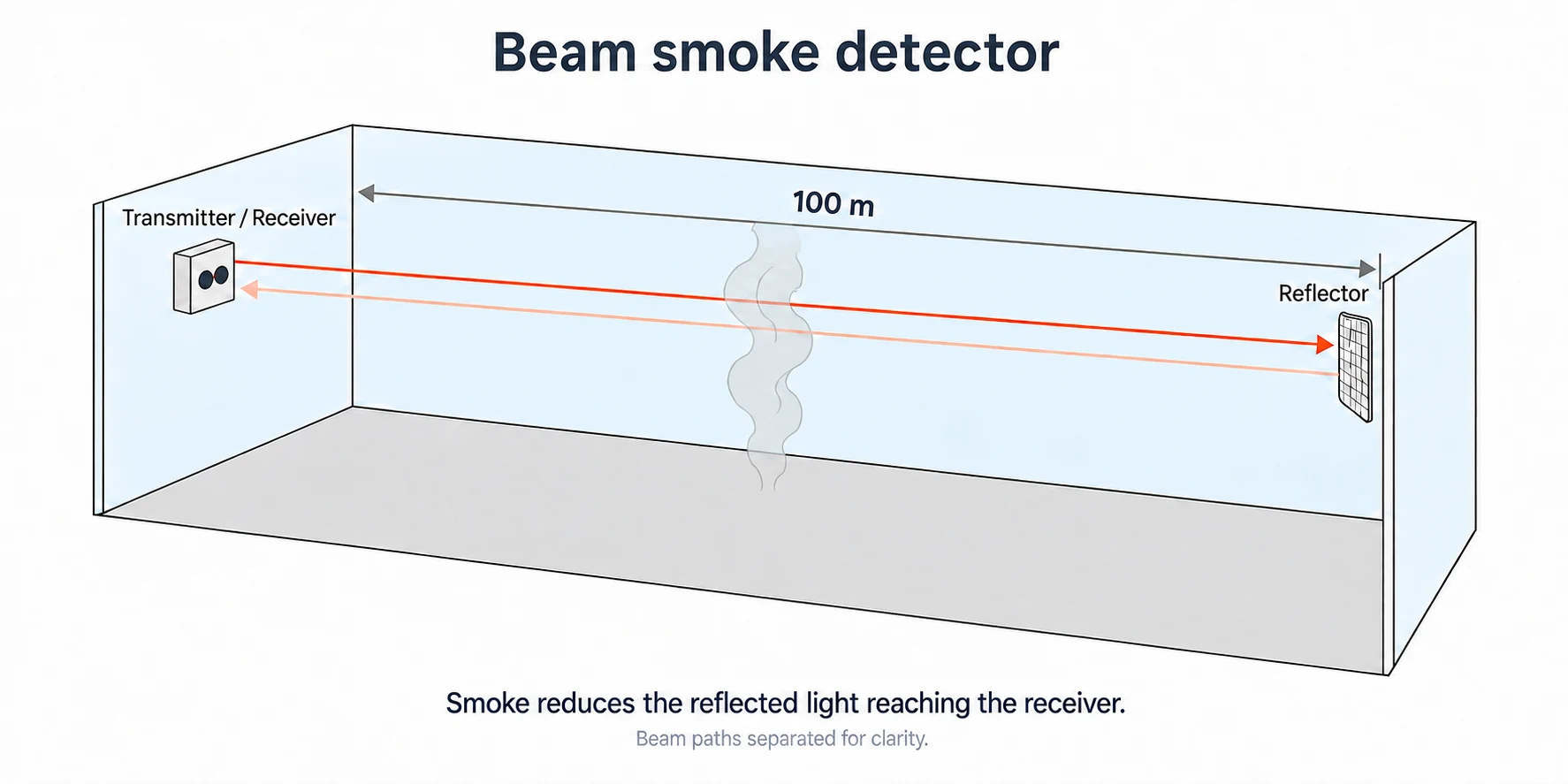
Beam smoke detectors detect smoke by monitoring a reduction in received infrared light across large spaces such as warehouses and halls. In the reflective arrangement shown here, the transmitter and receiver share one unit, while a reflector returns the light across the monitored space.

Reflective beam smoke detector with a combined transmitter and receiver facing a reflector across a 100 m illustrative span.
Illustrative arrangement, not an installation drawing. Infrared light paths are shown for clarity.

Long-Range Beam Detector Optics

My most extensive optical design work involved long-range beam smoke detectors (Mavili Elektronik, Teknim Elektronik).

This work included lens selection, focal-position determination, lens-holder design, transmitter–receiver spacing, reflector selection, and detection-range and angular-tolerance testing.

Additional Optical Work

  • Optical alignment for optical encoders (Fenac Encoders & Sensors).
  • Optical window selection for flame detectors (Mavili Elektronik).
  • Optical window selection for elevator-door photocells (Fenac Encoders & Sensors).
  • Optical component and window selection for laser distance-sensing systems (Fenac Encoders & Sensors).
  • Optical design and component selection for diffuse sensors (Fenac Encoders & Sensors).
  • Commissioning custom optical filter glass to simulate the attenuation of light by smoke during beam-detector testing (Mavili Elektronik, Teknim Elektronik).

Further reading