1. Introduction
CE marking in electronic products is often perceived merely as “having tests performed.” In reality, however, this process begins with understanding the correct directive, selecting the appropriate standards, and technically demonstrating safety.
In this third and final part of the series, we address—specifically within the scope of the Low Voltage Directive (LVD)—where tests are defined, how they are accepted, and what manufacturers are required to do in practice, all within a systematic framework. In Part 1, we examined the general structure of CE marking, and in Part 2, we covered EMC requirements. In this part, we clarify how tests are determined under the LVD, the role of harmonised EN standards, and how conformity is demonstrated in practice.
2. What Is the LVD?
When not properly designed, electrical products can pose serious risks such as electric shock, overheating, fire, and mechanical hazards. To control these risks while ensuring the free movement of products within the EU internal market, the European Union introduced the Low Voltage Directive (LVD).
The Low Voltage Directive (2014/35/EU) is an EU directive that requires electrical equipment operating within certain voltage limits to provide a high level of protection for persons, domestic animals, and property.
At this point, one critical clarification must be made: The LVD is not a test standard. The LVD does not define how a product should be tested; it defines the level of safety that must be achieved.
3. Scope of the LVD
The LVD applies to electrical equipment operating within the following voltage ranges:
- 50 – 1000 V AC
- 75 – 1500 V DC
These values refer to the rated input or output voltage of the equipment. Internal voltages remain relevant to the product’s risk assessment and safety design, but a higher voltage generated only inside the product does not, by itself, bring equipment whose input and output ratings are below the thresholds into the scope of the LVD.
The LVD covers a very broad range of products, from household appliances to industrial equipment. Despite the term “low voltage,” the objective is to ensure the safety of all electrical products that carry a high potential risk.
4. Products Within Scope (Examples)
Examples of products evaluated under the LVD include:
- Household appliances (washing machines, ovens, coffee machines)
- Power supplies and adapters
- Lighting luminaires and LED drivers
- Electric motors
- Cables, plugs, and sockets
- Industrial control and power equipment
The common characteristic of these products is that they use, transmit, or convert electrical energy and can pose serious safety risks if improperly designed.
5. Products Outside the Scope (Annex II)
Not every electrical product falls within the scope of the LVD. Some products are explicitly excluded under Annex II, primarily because they are regulated by other EU directives.
Annex II includes:
- Electrical equipment for use in an explosive atmosphere
- Electrical equipment for radiology and medical purposes
- Electrical parts for goods and passenger lifts
- Electricity meters
- Plugs and socket outlets for domestic use
- Electric fence controllers
- Radio-electrical interference as a phenomenon
- Specialised electrical equipment for ships, aircraft, or railways that complies with safety provisions drawn up by relevant international bodies
- Custom-built evaluation kits intended solely for professionals in research and development facilities
Being outside the scope of the LVD does not mean that these products have no safety requirements; it simply means that they are subject to different directives.
Annex I (Safety Objectives): Defines the essential safety objectives that an electrical product must meet in order to be considered safe.
Annex II: Lists the products and situations that are excluded from the scope of the LVD.
Article 3: Stipulates that a product may be placed on the EU market only if it has been designed and manufactured in accordance with good engineering practice and does not endanger people, animals, or property under normal conditions of use.
You can review the directive in detail via the link below.
https://eur-lex.europa.eu/legal-content/EN/TXT/?uri=CELEX:32014L0035
6. Components
One of the most frequently misunderstood topics within the scope of the LVD is the CE marking requirement for components.
Not every electronic component is required to carry a CE marking.
6.1 Basic Electronic Components
Basic components that are intended solely for incorporation into other equipment and whose safety cannot be assessed independently are generally evaluated as part of the final product rather than CE-marked under the LVD on their own. Examples include:
- Integrated circuits (ICs)
- Diodes, transistors
- Resistors, capacitors, inductors
- Optocouplers
Their safety still matters: component ratings, insulation systems, temperature limits, and relevant component standards form part of the final equipment’s conformity assessment.
6.2 Components and Finished Equipment That May Fall Within Scope
Certain items—such as fuses, power supply units, some transformers, motors, and power modules—may fall within the LVD when they are placed on the market as finished electrical equipment for an intended use and their rated input or output voltage is within the LVD range.
There is therefore no reliable rule that every transformer, motor, or power module must carry CE marking. The decision depends on the product’s intended use, level of completion, manner of placing on the market, applicable sector legislation, and voltage ratings. Components intended exclusively for incorporation may instead be assessed through the conformity assessment of the final equipment.
7. Essential Safety Requirements (Article 3 & Annex I)
The foundation of the LVD is Article 3 and Annex I. The Directive requires that electrical equipment be designed and manufactured in accordance with good engineering practice and that it does not pose a hazard under proper installation, maintenance, and foreseeable conditions of use.
These safety objectives form the technical rationale behind the tests defined in the selected EN standards.
8. Safety Objectives
The safety objectives defined in Annex I can be broadly grouped into three main categories:
8.1 Electrical Safety
- Access to live parts must be prevented
- Adequate insulation must be provided
- The risk of electric shock must be eliminated
8.2 Thermal Safety
- Overheating must be prevented
- The risk of burning and fire must not be created
8.3 Mechanical and Physical Safety
- Structural integrity must be ensured
- The product must be safe against external influences
At this point, the LVD defines not “how to test,” but “the level of safety that must be achieved.”
9. Why Are Tests Not Defined in the LVD?
The question “Where are the LVD tests?” is frequently asked.
The answer is clear: tests are not defined in the LVD. This is because the LVD is a legal text, while test methods are the subject of technical standards.
For this reason, there is no legal concept of an “LVD test.” The correct expression is standard tests performed to demonstrate conformity with the LVD.
10. How Are Tests Defined and Accepted?
The detailed test methods normally come from product-specific or generic safety standards. When the reference of a harmonised EN standard has been published in the Official Journal of the European Union (OJEU), applying that standard within its stated scope can provide a presumption of conformity with the corresponding LVD safety objectives. The process follows these steps:
- The product type is identified
- The relevant standard, applicable parts, edition, amendments, and OJEU status are verified
- The tests defined in the standard are applied
- Presumption of conformity applies to the safety objectives covered by the published harmonised standard
This approach is known as Presumption of Conformity.
11. Standard Selection and Verification Approach Based on Product Type
Within the scope of the Low Voltage Directive, the first and most critical step in conformity assessment is correctly determining which family of standards applies to the product. This decision is not based on the commercial name or marketing description of the product, but on its main function, intended environment of use, and target user profile.
Once the product type has been determined, the appropriate EN standard that technically addresses the safety objectives defined in Annex I is selected. Presumption of conformity depends on the reference published in the OJEU, including any limitations, transition dates, amendments, or withdrawal dates stated there.
11.1 Product – Standard – Verification Source Relationship
The mappings presented in this table show the most commonly used and inspection-accepted product–standard relationships within the scope of the LVD. Each standard defines technical requirements by considering the risks specific to its product group, including electrical safety, thermal risks, mechanical robustness, and foreseeable fault conditions.
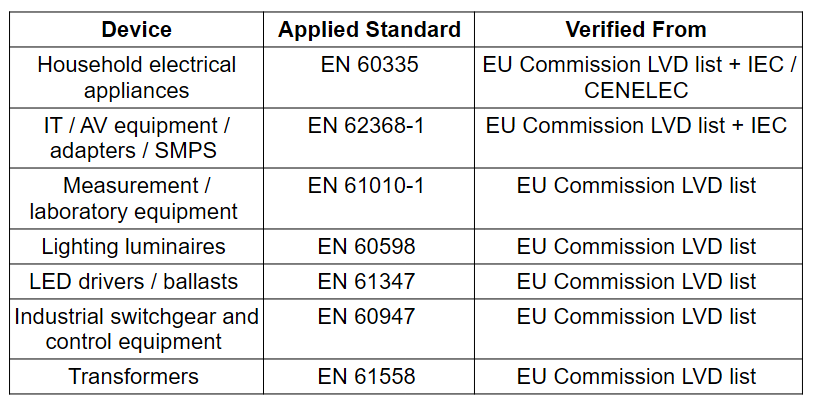
For example, household appliances normally use EN 60335-1 together with the applicable EN 60335-2-x particular standard. Luminaires use EN 60598-1 with the relevant EN 60598-2-x part; LED control gear commonly uses EN 61347-1 with the applicable EN 61347-2-x part. The same product-specific selection principle applies to the EN 60947 and EN 61558 families.
11.2 Are Harmonised Standards Mandatory?
The application of harmonised EN standards is not legally mandatory. However, standards whose references are published in the OJEU provide manufacturers with a presumption of conformity for the safety objectives they cover. This does not prevent market-surveillance authorities from examining the product or its technical documentation.
When harmonised standards are not applied, are applied only partly, or do not cover every relevant hazard, the manufacturer must document the alternative technical solutions and demonstrate that the applicable safety objectives are met. Because the European Commission’s consolidated summary list is informational and may lag behind legal publications, the latest OJEU implementing decisions should be checked.
12. Implementation of Tests and Technical Documentation
The LVD uses Module A — Internal Production Control. It does not require a notified body to participate in the conformity assessment. The manufacturer remains solely responsible for ensuring and declaring that the equipment satisfies the applicable requirements, although external laboratory testing may be used as supporting evidence.
12.1 Tests Performed by the Manufacturer
For tests performed by the manufacturer to be considered acceptable, the suitability of the test equipment, compliance of the test methods with the relevant EN standard, and traceable reporting of the results must be ensured. In this case, the entire burden of proof rests with the manufacturer.
12.2 Accredited Laboratory Tests
Testing by a competent accredited laboratory can provide strong, traceable evidence for the technical file, particularly for complex products or tests requiring specialised facilities. It is optional under the LVD and does not transfer legal responsibility away from the manufacturer. A voluntary certificate by itself is not a substitute for the applicable conformity assessment, technical documentation, EU Declaration of Conformity, and CE marking obligations.
12.3 Technical File Content
Within the scope of the LVD, the technical file is not limited to test reports alone. The following elements must be included in a holistic manner:
- Product description and intended use
- Risk analysis and implemented risk control measures
- Design and manufacturing drawings, schematics, and explanations needed to understand them
- List of harmonised standards applied in full or in part, including the exact editions and amendments
- Description of alternative technical solutions where harmonised standards were not applied or did not cover a hazard
- Design calculations, examinations, and test reports
- User manual and safety instructions
This documentation must be structured in a way that demonstrates the product’s safety and conformity. The manufacturer must retain the technical documentation and EU Declaration of Conformity for 10 years after the electrical equipment has been placed on the market.
12.4 Practical LVD Conformity Workflow
- Identify every applicable EU legal act and confirm whether the product falls within the LVD voltage scope.
- Define the intended use, users, environment, reasonably foreseeable misuse, and applicable hazards.
- Select the relevant safety-standard family, product-specific parts, edition, amendments, and current OJEU reference.
- Apply risk-control measures through the design, then perform and document the required examinations, calculations, and tests.
- Compile the technical documentation and ensure that series production remains consistent with the assessed design.
- Draw up and sign the EU Declaration of Conformity under the manufacturer’s sole responsibility.
- Affix the CE marking and provide product identification, manufacturer contact details, instructions, and safety information as required.
13. Conclusion
The Low Voltage Directive aims to ensure that an electrical product remains safe not only under laboratory conditions, but also in real-world usage scenarios. For this reason, the LVD provides a holistic safety framework covering design, manufacturing, and the entire product lifecycle.
With this three-part series, my aim was to explain the rationale behind CE marking not by memorizing EMC, LVD, and RoHS as separate topics, but by showing how they should be addressed together from an engineering perspective. Viewing the CE process not as “tests performed at the end,” but as a systematic process that must be managed starting from the design phase forms the basis of this approach.
You are welcome to share your questions, different product scenarios, or your own experiences in the comments; let’s evaluate them together. Thank you for reading — I hope this series has been useful and enjoyable.
References
- European Parliament and Council, Directive 2014/35/EU — Low Voltage Directive, Official Journal of the European Union, 2014.
- European Commission, Harmonised Standards under the Low Voltage Directive (2014/35/EU).
- IEC/EN 62368-1, Audio/video, information and communication technology equipment — Safety requirements.
- IEC/EN 61010-1, Safety requirements for electrical equipment for measurement, control, and laboratory use.
- IEC/EN 60335-1, Household and similar electrical appliances — Safety — General requirements.
- IEC/EN 60598-1, Luminaires — General requirements and tests.
- European Commission, Low Voltage Directive (LVD) — Implementation and Guidance.
- European Commission, The “Blue Guide” on the Implementation of EU Product Rules 2022.