A Terrarium of Light and Color
A personal terrarium project exploring plant lighting, colorful foliage, and UV-fluorescent stones as I build a miniature glowing world.
It has been more than ten years since I made my first terrarium. Now I have a completely different terrarium in mind, one that reminds me of Pandora from Avatar: colorful plants and a glowing planet.
This time, I’m using the power of light to bring my idea to life.
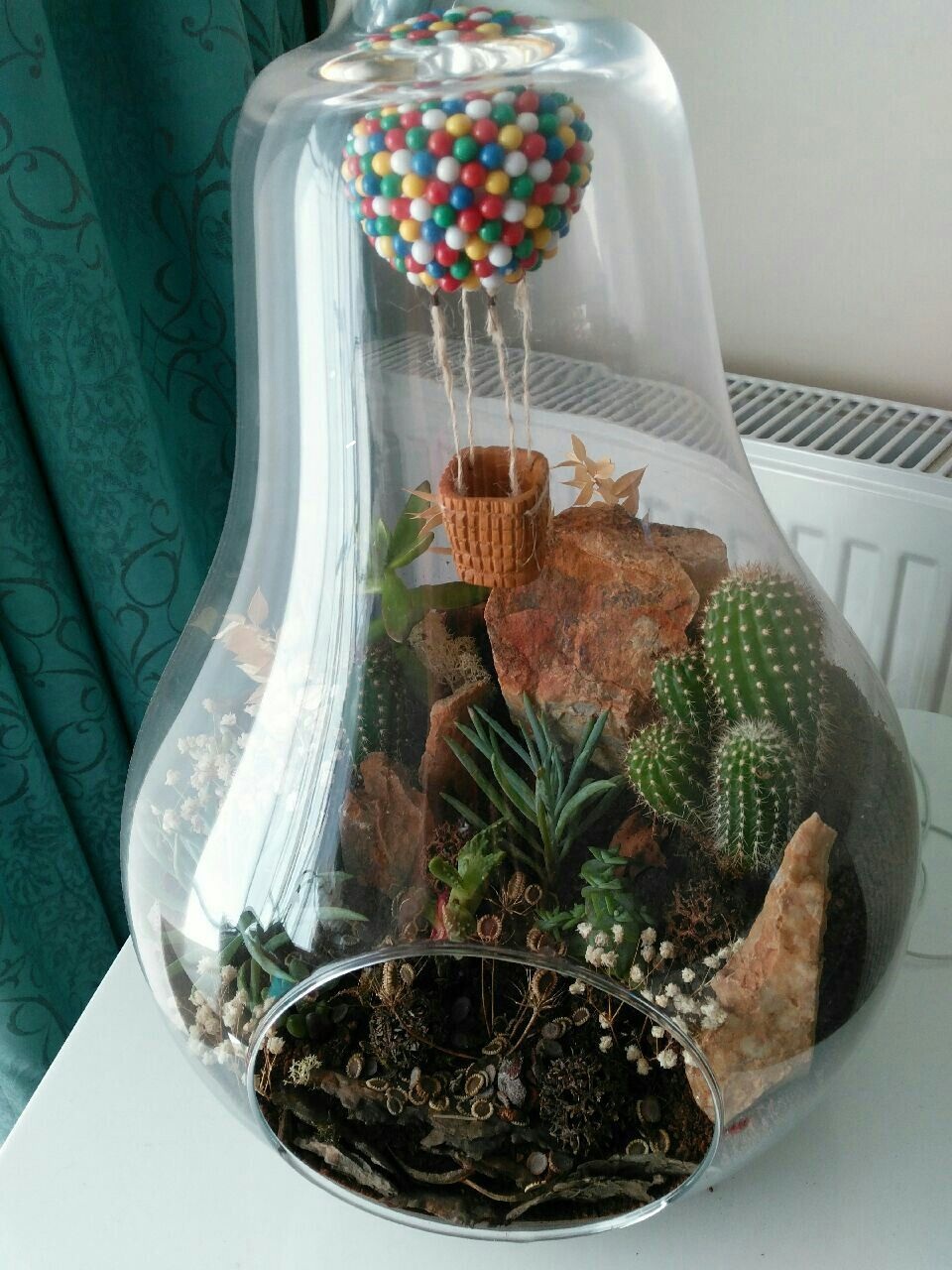
I’m starting with the plants as I design my miniature planet. I want my terrarium to be visually striking, but healthy plant growth matters just as much as its appearance. So my first step is to understand what light the plants need and design a suitable lighting fixture.
Virginia Tech’s article How to Choose the Right LED Grow Lights for Your Plants explains that the human eye is more sensitive to green-yellow light, while plants use light differently. Ordinary household lights are therefore not always the best choice for plants. Rather than lumens, which are weighted to human vision, plant lighting is often described using PAR (400–700 nm) and PPFD (µmol/m²/s), the density of photosynthetic photons reaching a surface. (1, 2)
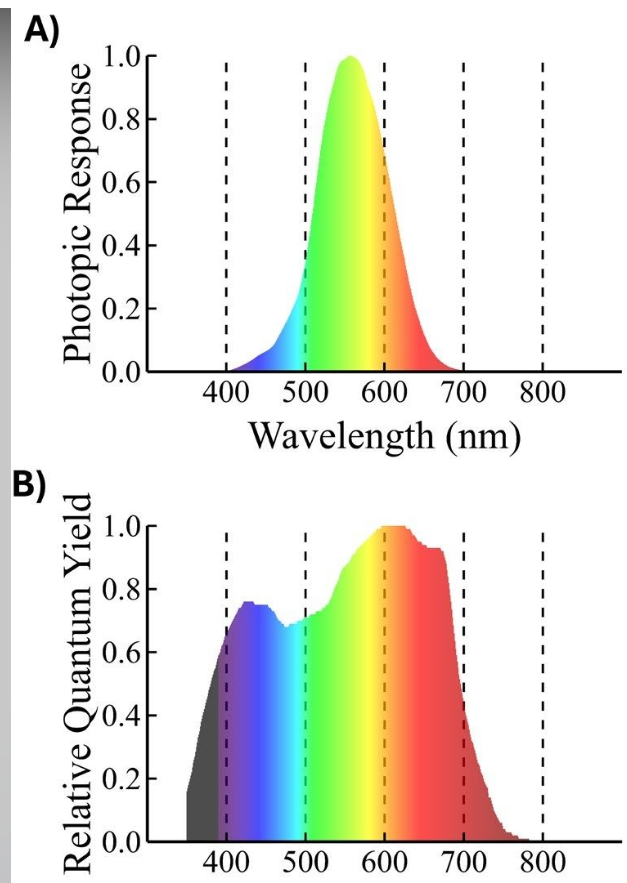
How Different Wavelengths of Light Affect Plants
Ultraviolet light / UV (280–400 nm)
UV is not included in most plant-growing fixtures. Used in a controlled way, however, it can increase the production of pigments and secondary compounds such as anthocyanins and flavonoids. This can change the color and chemical properties of some plants.
High UV doses can suppress growth. UV LEDs are also much less electrically efficient than red and blue LEDs. UV is therefore not essential for most plants. (1)
Blue light (400–500 nm)
Blue light plays an important role not only in photosynthesis but also in plant development. A higher proportion of blue light generally leads to smaller leaves and shorter stems, creating more compact growth. This can benefit some ornamental plants, but excessive blue light may stunt plants or distort their form.
Blue light can also support red leaf pigments in some plants. Some grow-light fixtures keep blue light below 20–30%, but the ideal proportion depends on species, growth stage, and other lighting conditions. This is not a universal rule. (1)
Green light (500–600 nm)
Plants also use green light for photosynthesis. However, green LEDs are generally less electrically efficient than red and blue LEDs, so they are not usually a major component on their own in commercial grow lights.
Green light helps people see plants in their natural colors. It can make nutrient deficiencies, color changes, and pest damage easier to spot. (1, 2)
Red light (600–700 nm)
Red light is among the most efficient wavelength regions for photosynthesis. Red LEDs also generally convert electricity into light more efficiently than blue and green LEDs.
Because of their high efficiency, red LEDs are a major component in many commercial grow lights. Some red-blue fixtures contain more than 70% red light, but this should not be treated as the ideal ratio for every plant or application. (1)
Far-red light (700–800 nm)
Far-red light affects plant growth form. Replacing a small portion of blue, green, or red light with far-red can increase growth in some plant species.
High far-red proportions can cause excessive stem elongation in some species. Some applications use low levels (below about 5–10%), but the suitable amount depends on the species and desired growth form. (1)
Wavelength Combinations in Plant-Growing LEDs
White light and Kelvin
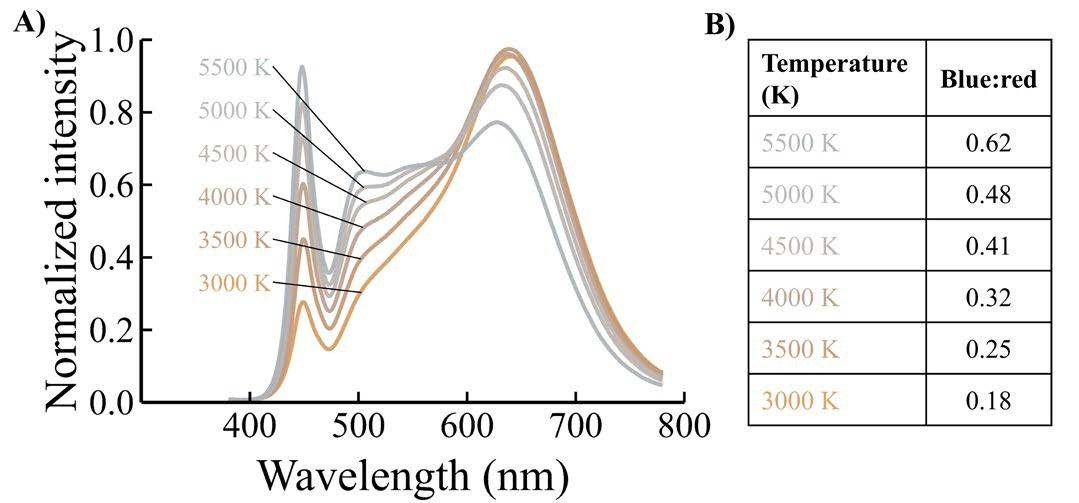
The color temperature of white LEDs is expressed in kelvin (K). Lower values look warmer and more yellow; higher values look cooler and bluer.
In Virginia Tech’s comparison, the blue-to-red ratio rises from 0.18 for a 3,000 K LED to 0.62 for a 5,500 K LED. A higher proportion of blue can support shorter stems and smaller leaves in many plants. (1)
These light spectra give me ideas for my terrarium. I’m curious to see how different light components will affect the plants and the atmosphere of my miniature planet.
As I imagined a glowing planet, I realized I needed more than LEDs and plants. My son’s rock collection caught my eye. Some stones fluoresce under UV light.
Fluorescence and Phosphorescence in Minerals
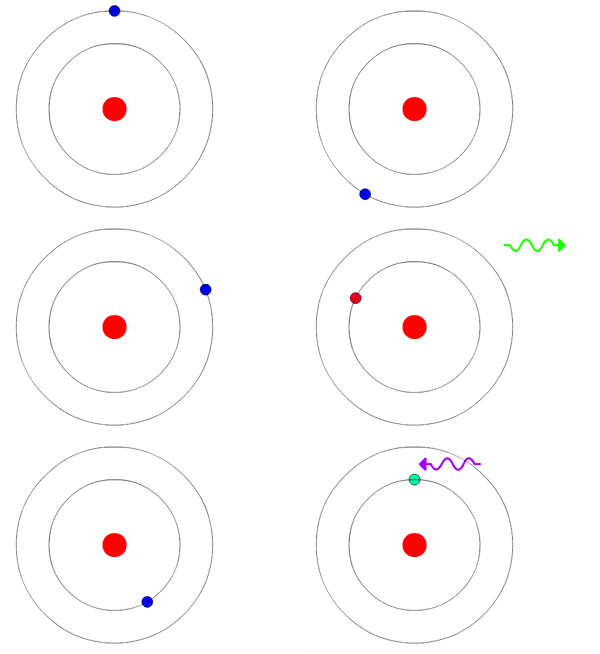
Some minerals absorb ultraviolet (UV) light and emit visible light. Luminescence is the production of light through physical or chemical processes rather than heat. When luminescence follows the absorption of light, it is called photoluminescence. Two important types are fluorescence and phosphorescence. (5, 7)
Fluorescence occurs when UV light excites atoms or ions in a mineral. Electrons absorb energy from UV photons and move from a lower-energy ground state to a higher-energy excited state. As they return to a lower energy level, they release some energy as visible light. The emitted light usually has a longer wavelength than the UV that excited it. Fluorescence continues while the UV source is on and stops almost immediately when it is switched off. (5, 7)
In phosphorescence, the return to a lower energy state is delayed after excitation. A mineral can therefore continue to glow for a while after the UV source is switched off. The duration depends on the mineral’s structure and transitions between energy levels. (5, 7)
A mineral’s chemical composition, crystal structure, and impurities affect its fluorescence. Most minerals do not fluoresce in pure form, although scheelite is an exception. Trace elements that enable fluorescence are called activators. Manganese and some rare-earth elements are examples. (5, 7)
Other elements can weaken or suppress fluorescence; these are called quenchers. Iron, for example, can suppress fluorescence in some minerals. Activators and quenchers help determine the emitted light’s color and brightness. (5, 7)
Minerals known to fluoresce include aragonite, calcite, fluorite, powellite, scheelite, sodalite, willemite, and zircon. Specimens of the same mineral can glow in different colors—or not at all—depending on their trace elements. (4, 5)
The UV wavelength also affects fluorescence. Mineral collectors commonly use 365 nm long-wave UVA and 254 nm short-wave UVC sources. Some minerals fluoresce more strongly under 365 nm, while others respond more strongly to 254 nm. Willemite and some calcite specimens can glow brightly under short-wave UV. (4, 5)
Visible light from a UV source can mask a mineral’s fluorescence. Mineral lamps may use special filters that reduce visible light while allowing UV to pass through, making fluorescence colors easier to see. (5, 7)
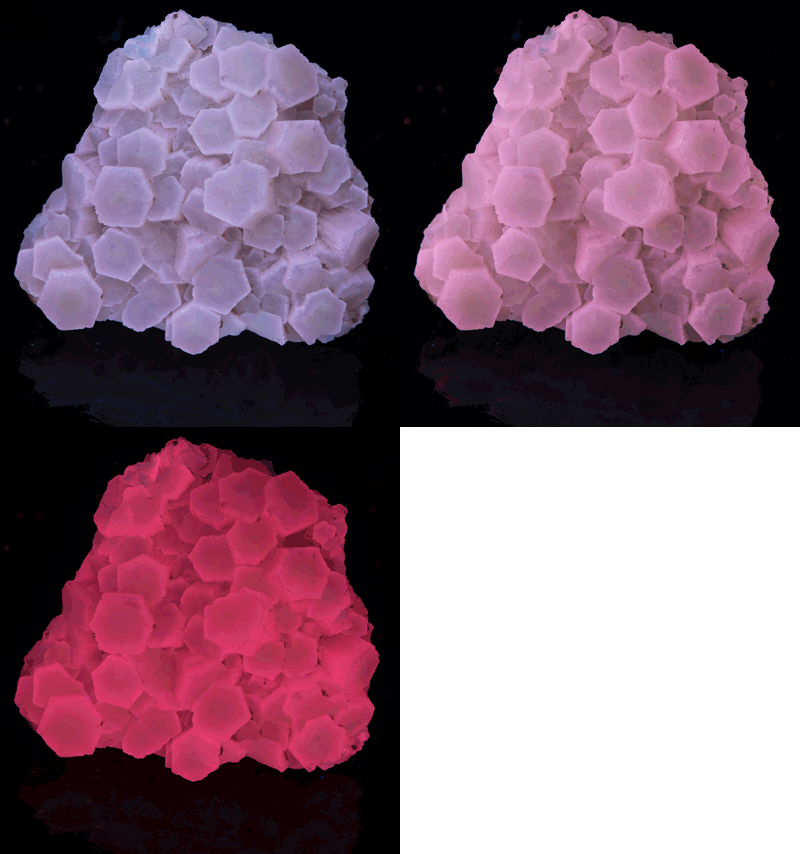
Fluorescent and Phosphorescent Minerals and Natural Stones
A mineral’s response to UV light depends on its chemical composition, crystal structure, and trace elements. (4, 5)
- Fluorite: Often blue-violet; some specimens fluoresce green. Certain specimens also show phosphorescence. (5)
- Calcite: Manganese-bearing specimens can fluoresce red, pink, or orange. Some calcite continues to glow briefly after the UV light is switched off. (5)
- Willemite: Known for bright green fluorescence, especially specimens from the Franklin area. Some specimens also show phosphorescence. (5)
- Sodalite: Some specimens fluoresce orange or yellow. Hackmanite, a variety of sodalite, can show fluorescence, phosphorescence, and a temporary UV-induced color change. (5)
- Scheelite: Often fluoresces blue-white under short-wave UV. (4, 5)
- Scapolite: Some specimens fluoresce yellow or orange-yellow. (5)
- Agate: Some banded chalcedony specimens show green or yellow-green fluorescence. (5)
- Opal and hyalite opal: Some hyalite opal specimens fluoresce bright green because of trace uranyl ions. (5)
- Petrified wood: Depending on the minerals present, some specimens fluoresce green, yellow, or other colors under UV light. (5)
- Yooperlite: A commercial name for sodalite-bearing syenite. Its normally gray surface can reveal bright orange patterns under UV light. (5)
- Franklin-area rocks: Some rocks from the Franklin and Sterling Hill deposits in New Jersey contain multiple fluorescent minerals. Green willemite and red calcite can create different colors on the same rock. (3, 5)
- Other minerals that may phosphoresce: Some specimens of celestite, colemanite, and sphalerite continue to emit light after the UV source is switched off. (5)
These properties do not apply to every specimen. The color, brightness, and duration of fluorescence or phosphorescence depend on the mineral and the UV source.
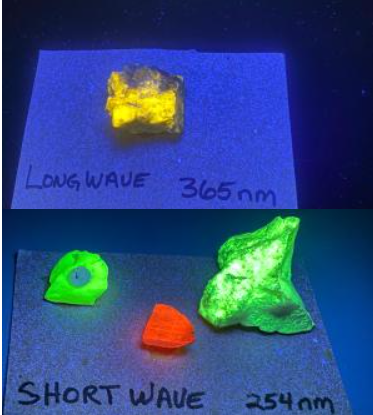
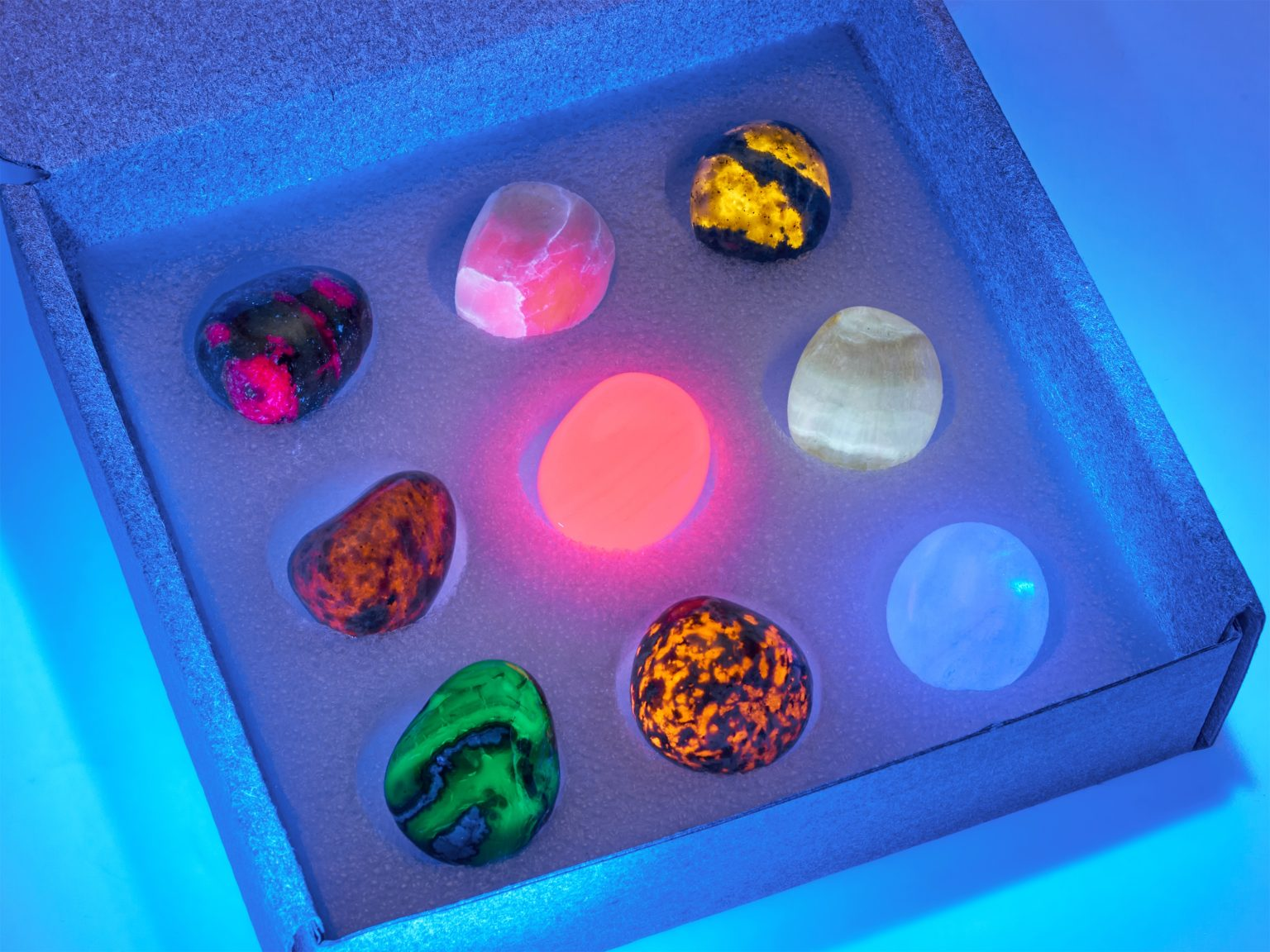
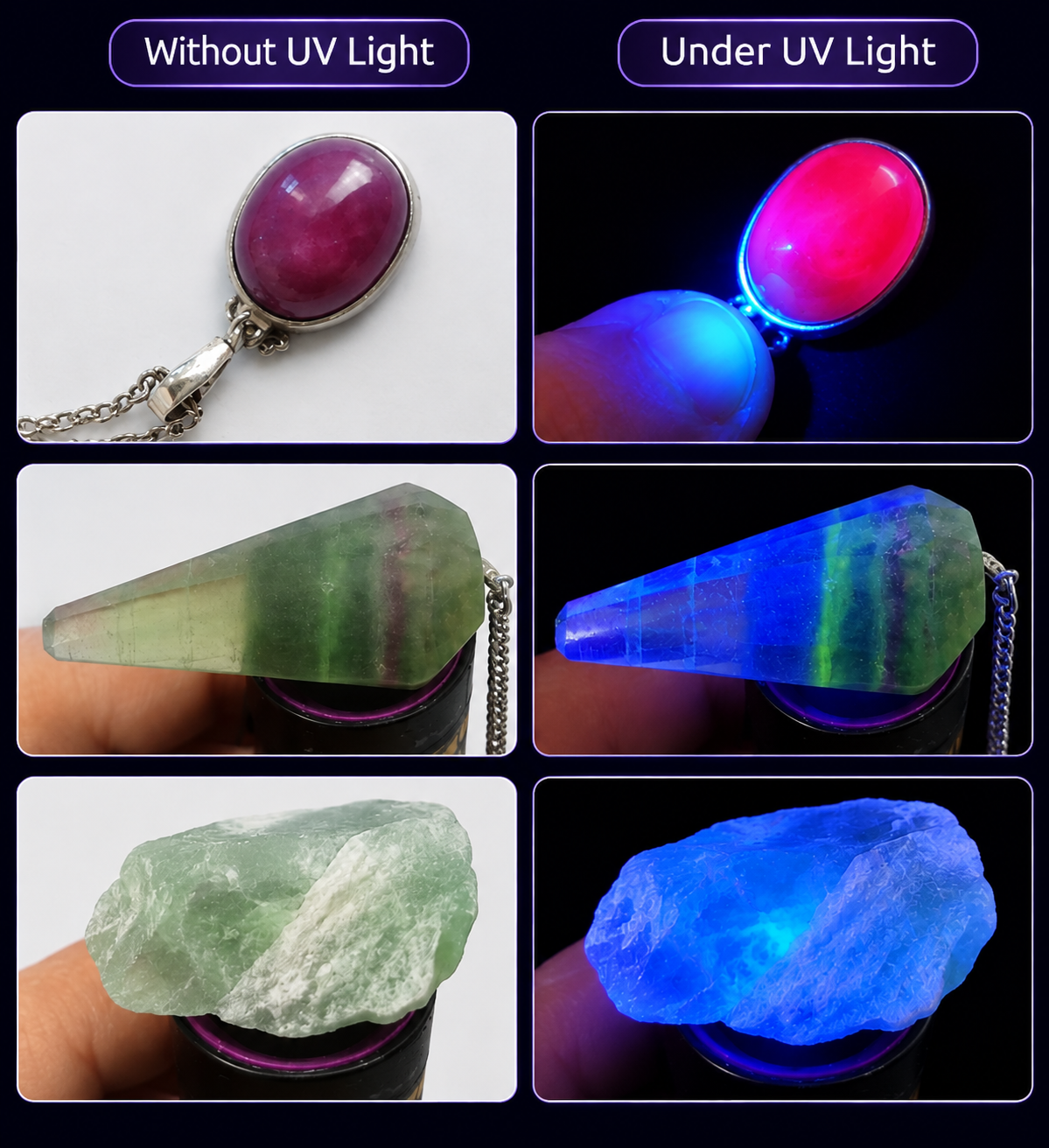
After reading about UV fluorescence, I ordered a 365 nm UV flashlight and started examining the stones I had at home. Unfortunately, I did not find many that glowed brightly, and I left out some that did not show up well in photographs. I will not be putting my ruby jewelry in the terrarium! I hope to find affordable specimens at a stone market. If you would like to help, I’d love to hear your ideas. I will consider whether the stones are safe and suitable for a closed terrarium, not just how they look.
Conclusion and Next Steps
In this article, I explored plants’ light needs, how different LED spectra affect their growth, and how natural stones fluoresce or phosphoresce under UV light.
I’m planning to design a lighting fixture that combines different light components. I’ll share the details and results in future posts.
You can follow the terrarium’s progress in the Free Zone section of my website. I’ll share my experiments and updates here as well.
I hope to share real photos of my miniature planet with you soon.
I’ll end with beautiful photographs of plants viewed under UV light. Stay tuned as I continue exploring the effects that light can reveal!
Illuminating Nature’s Spectrum — National Geographic
References
- Virginia Tech, How to Choose the Right LED Grow Lights for Your Plants.
- University of Minnesota Extension, Lighting for Indoor Plants and Starting Seeds.
- Fluorescent Mineral Society.
- Western University, Fluorescent Minerals.
- Geology.com, Fluorescent Minerals and Rocks.
- Arizona State University, UV (Ultraviolet) Fluorescence.
- Fluorescent Mineral Society, Fluorescence in Minerals.
- INCOOL, Fluorescent Minerals — Tumbled Stone Collection.